



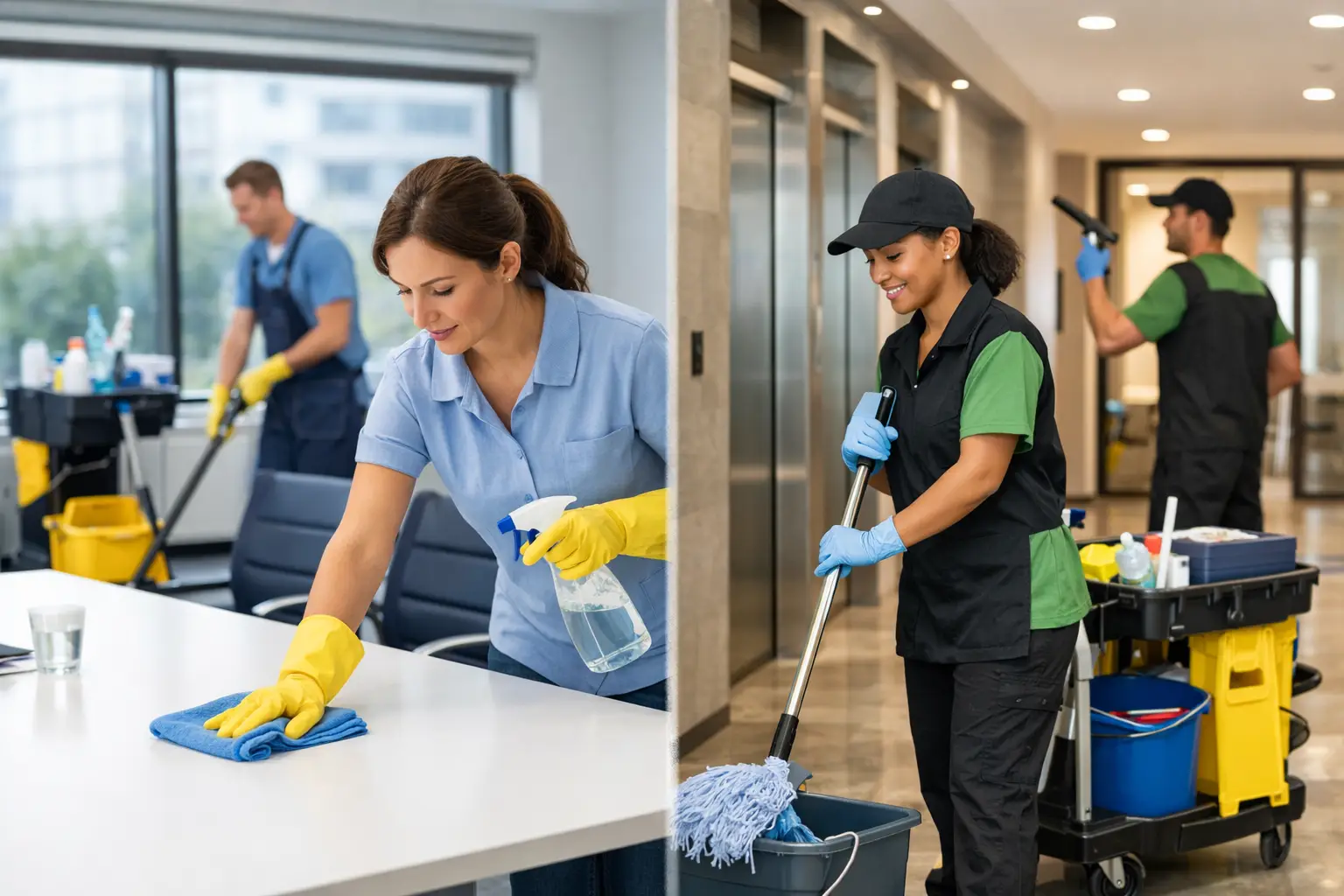
A missed trash pull, an unprepared community room, or restrooms that are not ready before the workday begins can quickly become a management problem. For property managers, office leaders, and HOA boards, the question of in house vs outsourced cleaning is less about who holds a mop and more about who owns the outcome when standards slip.
The right choice depends on the property, the work required, and how much time your team can realistically devote to staffing and supervising cleaning. An in-house model can offer immediate control. An outsourced provider can bring structure, flexibility, and a clearer division of responsibilities. Neither approach is automatically better for every facility.
In House vs Outsourced Cleaning: The Core Difference
With in-house cleaning, the property owner or management company hires and manages cleaning personnel directly. That team works within the organization and may handle daily tasks such as restroom cleaning, trash removal, breakroom upkeep, clubhouse cleaning, and common-area touchups.
Outsourced cleaning means a professional cleaning company supplies the team and works from an agreed cleaning plan. The provider may perform recurring office cleaning, janitorial service, apartment common-area cleaning, floor care, move-out cleaning, or scheduled deep cleaning, depending on the property’s needs.
The difference is not simply employment status. It is where the daily management work sits. An in-house arrangement puts hiring, scheduling, training, supply coordination, quality follow-up, and coverage planning on the property’s side. An outsourced arrangement shifts much of that operational work to the cleaning provider, while the client remains responsible for setting expectations and reviewing results.
For a small office with predictable needs, an in-house employee may be practical. For a multi-building community, a busy medical office, or an HOA with changing event schedules and high-use shared spaces, the management demands can grow quickly. The more variables a property has, the more valuable a defined service plan often becomes.
Where an In-House Cleaning Team Can Work Well
In-house cleaning can make sense when a facility has steady, full-time cleaning needs and enough internal oversight to support the team. A large campus, a high-traffic building with all-day needs, or a property that requires frequent on-site response may benefit from having cleaning personnel directly available.
Direct oversight is the biggest advantage. A facility manager can adjust priorities on the spot, assign a new task after an event, or redirect attention to a spill, lobby issue, or tenant request. The team may also become familiar with the building’s routines, preferred setup, and areas that need more frequent attention.
However, this control requires active management. Someone must create schedules, address absences, monitor performance, order materials, and make sure recurring work does not get lost behind urgent requests. When the same manager is also responsible for residents, tenants, vendors, maintenance, and budgets, cleaning oversight can become one more critical task competing for limited time.
In-house teams can also be difficult to scale during move-out periods, post-construction work, seasonal traffic, special events, or inspections. If demand rises beyond the available staff, the property must find a way to cover it without compromising the daily work that cannot wait.
What Outsourced Cleaning Changes
An outsourced provider gives property and facility teams a dedicated point of accountability for the cleaning scope. Instead of managing individual cleaners day to day, the client communicates priorities, schedules, access requirements, and standards with the service provider.
This can be especially helpful for commercial properties with multiple service areas. An office may need nightly desk-area and restroom cleaning, while an apartment community may need lobbies, elevators, hallways, fitness rooms, and clubhouses addressed on different schedules. A customized plan allows the work to match actual traffic patterns rather than treating every area the same.
Outsourcing can also reduce disruption when schedules change. A professional provider is positioned to coordinate staffing around recurring appointments, one-time deep cleaning, tenant turnover support, or an event in a community room. That does not remove the need for communication, but it can simplify the process for a busy manager.
The trade-off is that the provider will not know every detail of the property on day one. Strong results depend on a clear walkthrough, a practical scope of work, reliable access arrangements, and regular communication. Outsourcing works best when the cleaning company is treated as an operational partner, not as an afterthought brought in only after complaints arise.
Compare the Real Cost, Not Just the Hourly Rate
Cost is often the first consideration in the in house vs outsourced cleaning decision, but the hourly figure alone rarely tells the full story. An internal cleaning program involves more than wages. It may require time for recruiting, interviewing, onboarding, scheduling, supervision, payroll administration, supply purchasing, equipment maintenance, and finding coverage when staffing changes.
Outsourced cleaning is generally evaluated through a defined service scope. That can make budgeting easier because the client can see what tasks, areas, and frequencies are included. It also creates a useful conversation about priorities. If a property needs daily restroom service but only weekly floor detailing, the plan can be built around that reality.
Still, a lower proposal is not always the better value. If the scope is too vague, key tasks may be assumed rather than scheduled. Ask how often common areas, touchpoints, trash rooms, restrooms, breakrooms, and entryways will be serviced. For HOAs and multifamily properties, clarify how clubhouse reservations, event cleanup, and higher-traffic weekends are handled.
A good comparison looks at the total administrative burden, expected coverage, service frequency, and visible condition of the property. The goal is not merely to spend less. It is to choose a setup that keeps the space presentable without creating a new management burden.
Control Comes From Clear Standards
Some managers hesitate to outsource because they worry about losing control. In practice, control comes from setting clear expectations and reviewing performance, whether the cleaners are internal or external.
Start with the areas that shape daily impressions. For an office, that may include entry glass, reception areas, restrooms, breakrooms, conference rooms, and trash removal. For an HOA or apartment community, it may include lobbies, hallways, elevators, clubhouses, fitness areas, shared restrooms, and leasing spaces.
Then define the service rhythm. Daily, several times per week, weekly, and monthly work should be distinguished. High-touch and high-visibility areas need more attention than storage rooms or low-traffic back areas. This simple step prevents the common problem of a cleaning plan that sounds complete but does not reflect how residents, guests, employees, or tenants actually use the property.
Communication should also have a clear path. Decide who reports concerns, who can request add-on work, and how schedule changes are communicated. A property manager should not have to repeat the same instructions after every event. A cleaning provider should not be left guessing about access, priorities, or whether a room has been reserved for a resident function.
A Hybrid Model May Be the Best Fit
The choice does not always have to be all in-house or all outsourced. Many properties use a hybrid approach that keeps a maintenance or porter team focused on immediate daily needs while outsourcing recurring janitorial service, deep cleaning, floor care, or pressure washing.
This can work well when an on-site employee needs to handle quick response tasks but does not have the time, equipment, or schedule capacity to maintain every shared space to a consistent standard. It can also help during apartment turnovers, construction projects, or busy seasons when the normal workload increases.
The key is to avoid overlap and confusion. Assign daily touchups, routine cleaning, specialty work, and event-related responsibilities clearly. When everyone knows who handles what, issues are less likely to sit unresolved because each side assumes the other is responsible.
Questions to Ask Before Choosing a Cleaning Model
Before making a decision, look closely at your property’s actual demands. How many spaces need service? What hours are appropriate for cleaning? Which areas create the most complaints or the strongest first impression? How often do schedules change? Who will be available to inspect work and handle staffing issues?
For outsourced service, ask for a detailed scope that matches those answers. The plan should identify the spaces being cleaned, the frequency of key tasks, the preferred schedule, and the process for communicating special requests. This is especially valuable for commercial properties and HOAs where residents, tenants, visitors, and staff all experience the same common areas differently.
Call The Helper LLC works with clients to shape cleaning plans around the real needs of offices, shared facilities, community spaces, and properties throughout San Diego County. The most effective plan is one your team can understand, monitor, and rely on without having to manage every cleaning detail themselves.
A clean property should make the day easier for everyone who walks through it. Choose the model that gives your team enough visibility to protect standards and enough support to keep those standards from becoming another item on an already full to-do list.


Comments are closed